

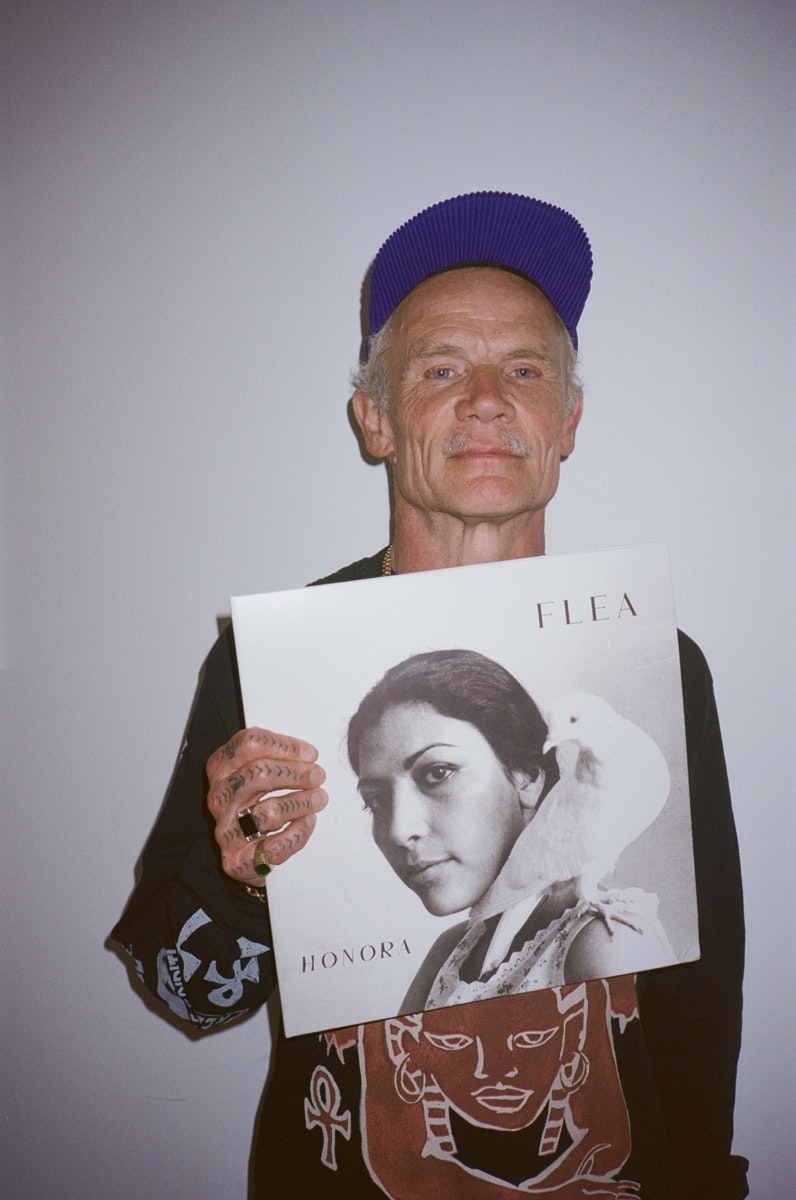
HONORA
FLEA
Words Bartolomeo Celestino
Wearing ISSEY MIYAKE
FLEA
Words Bartolomeo Celestino
Wearing ISSEY MIYAKE
MOTHER EARTH IS PREGNANT FOR THE THIRD TIME
FOR Y'ALL HAVE KNOCKED HER UP
I HAVE TASTED THE MAGGOTS IN THE MIND OF THE UNIVERSE
I WAS NOT OFFENDED
FOR I KNEW I HAD TO RISE ABOVE IT ALL
OR DROWN IN MY OWN SHIT
THE VISIONARY - FLEA - BUILD A BRIDGE, ITS WHERE THE COURAGE IS
Text and Photography BARTOLOMEO CELESTINO
A protagonist is not necessarily the loudest figure in the frame, nor the
one positioned at its centre, but the force around which energy
reorganises itself. Flea has always occupied this rarer category of
presence. To watch him perform is to witness motion before meaning,
instinct before structure, a kind of physical thinking where the body
arrives at truth faster than language. Across decades of cultural noise and
reinvention, he has remained a figure of restless velocity: feral, precise,
improbably lyrical.








His bass does not simply underpin songs; it destabilises and redefines them, turning rhythm into narrative and momentum into emotion. In an era obsessed with surfaces, Flea persists as something far more difficult to manufacture, a visibly human voltage, equal parts chaos and discipline, forever suggesting that the most compelling protagonists are those who appear unable to stand still inside their own mythology.
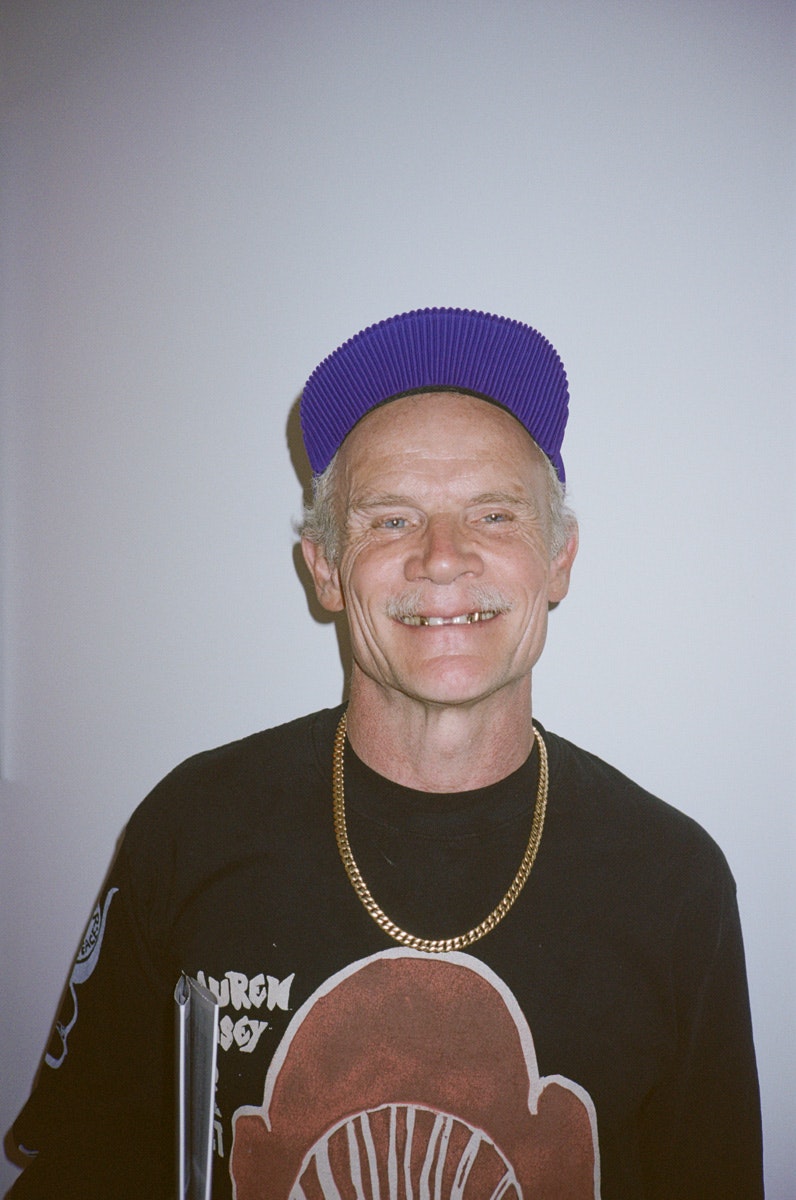
Some days arrive with a quiet sense of
improbability. Flea, relaxed yet
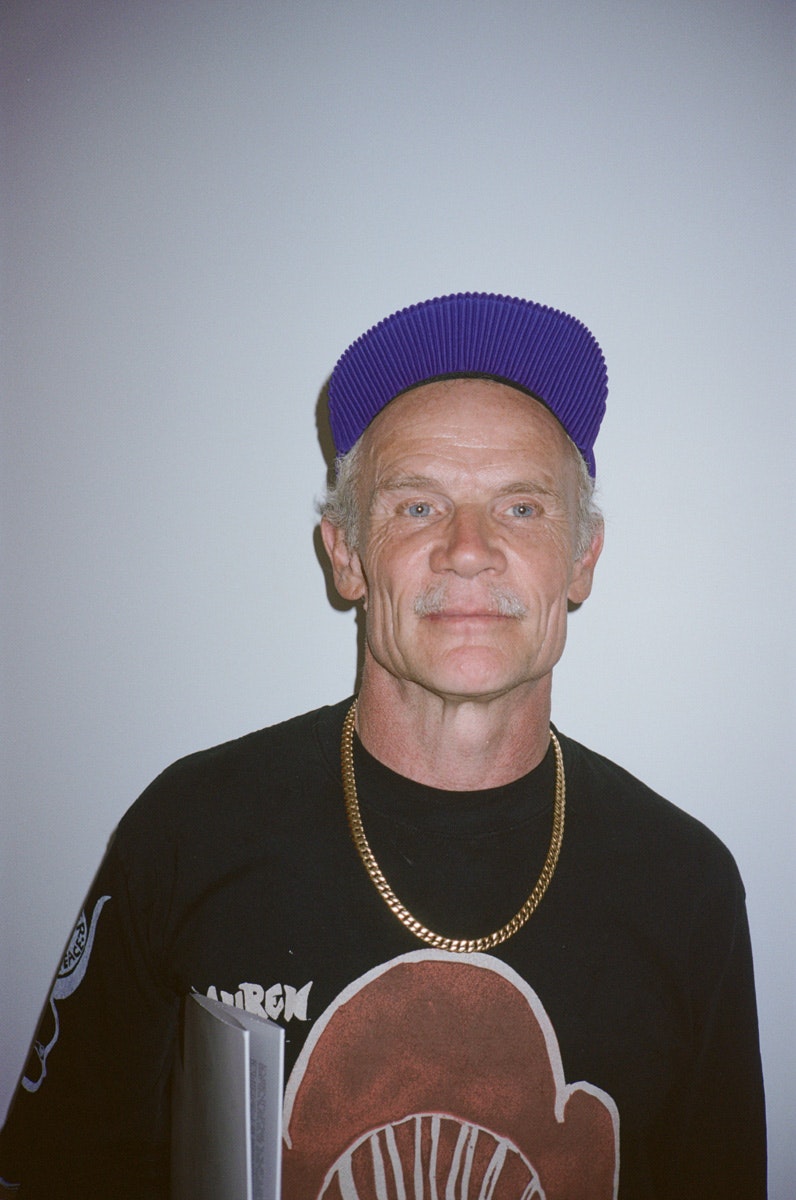
electrically present, wearing a Lakers
purple Issey Miyake cap, gestures toward
the oversized chair at the front of the
room and says, almost mischievously,
“take the king chair.” The invitation
carries theatre, but I decline the implied
spotlight, drifting instead toward
something deeper, a chair designed less
for posture than for surrender. The kind
you can disappear into, eyes closed. The
kind that permits listening rather than
observing.
He kneels by the mixer with casual
familiarity and plugs his iPhone into the
jack, but before the music begins he
speaks about the horn with the ease of
someone describing a lifelong attachment
rather than an adopted instrument. The
hours of practice, the years of devotion.
Playing trumpet, he reminds me, was
never an experiment or late career
diversion. It was the original impulse, the
earliest fixation. Years earlier, over Sri
Lankan noodles in Darlinghurst during
one of his Sydney visits, we had circled
this very subject. The conversation moved
instinctively through names that once
formed my own private mythology:
Miles, Wes, Thelonious, Milt, Dizzy, Bird,
Coltrane. The catalogue felt endless,
almost chaotic, stirring something long
dormant.
In the early 90s, I hauled jazz records
back to Australia from obsessive overseas
hunts in New York to Paris, sleeves worn,
luggage overweight, long before suitcases
obediently rolled on tiny wheels. Many of
those albums went straight to my brother,
destined for sampling sessions on his
small Akai MPC. Back then, I believed
sound itself could alter internal weather.
Sitting in that room, the memory returned
with unexpected clarity. Now here we
were.
With gratitude to Flea and special thanks to Stephen Pavlovic. Also in attendance, Legs, Giovanni and Enrico Paradiso.
Honora does not present as a stylistic
deviation but as a return of gravitational
force. The album’s architecture is
anchored in Flea’s enduring relationship
with jazz and the trumpet, the instrument
that predated the punk kid, and, in many
ways, foretold his musical identity. He
described the project with revealing
directness: time and space, he says, finally
allowed him to reconnect with his first
musical loves, jazz and the trumpet. The
phrasing resists the rhetoric of
reinvention. This is not departure. It is re
alignment.
That sensibility is inseparable from his
formative encounters with jazz, which he
recalls not as influence but revelation: “It
was the greatest thing I ever saw. The
wildness, warmth … straight bebop … I
knew there were higher things on this
earth.” The statement reads less like
nostalgia than recognition, as though the
horn represented a vocabulary of feeling
that existed long before career, genre, or
mythology intervened. Within Honora,
(who’s cover features his mother in law)
that early language resurfaces with
remarkable coherence. The trumpet is not
positioned as colour or accent but as a
primary expressive conduit, shaping the
album’s emotional and spatial logic.
As the album begins, the sound of his
trumpet fills the room with surprising
physicality. Not aggressive or declarative,
but enveloping. The record’s defining
characteristic is its commitment to
atmosphere. Only days earlier, I had
driven to Melbourne with the opening
track, A Plea, looping for hours, its mood
refusing to exhaust itself. The music
advances through patience, negative
space, and tonal liquidity rather than
density or virtuosity. The trumpet
reframes Flea’s presence entirely. The
instrument carries breath, fragility, and
restraint, qualities that stand in deliberate
contrast to the explosive muscularity
associated with his bass work. Listening
becomes immersive. The room seems to
dilate
The album’s interpretative centre becomes
most vivid in its reimagining of works
such as Maggot Brain and Wichita
Lineman. These pieces arrive with deeply
embedded cultural memory, yet Honora
treats them not as monuments but as open
terrain. Maggot Brain, historically
saturated with emotional weight, unfolds
here as an exercise in suspended time.
The performance privileges drift, texture,
and tonal atmosphere, allowing the
composition’s core emotional thesis,
isolation, vulnerability, interior vastness...
to expand rather than intensify.
Psychedelia emerges as structure rather
than effect, the music feeling unmoored,
guided by sensation and space.
Nick Caves vocals on Wichita Lineman
undergoes an equally striking
transformation. Its melodic framework
remains recognisable, but its emotional
delivery diffuses into something prismatic
and dreamlike. Familiar longing softens
into a luminous haze, subtly destabilising
expectation. Narrative clarity gives way to
mood, to feeling, to perception itself. The
song is not revisited. It is re experienced.
What unifies these interpretations is their
refusal of conventional homage. There is
no overt display of virtuosity, no theatrical
reinvention. Instead, Flea and the
ensemble lean into elasticity, tonal
ambiguity, and spatial awareness.
Psychedelia is articulated through pacing,
timbre, and interaction, aligning
seamlessly with jazz’s improvisational
ethos while preserving the emotional
DNA of the source material. Even the
inclusion of Frank Ocean’s ‘Thinkin Bout
You’ extends this logic, dissolving
boundaries between repertoires and eras.
The listener encounters altered conditions
rather than altered compositions. Honora ultimately registers as an
introspective document, a recalibration of
artistic centre rather than an expansion of
brand identity. It reveals continuity with
Flea’s earliest impulses, the trumpet
functioning as both origin point and
emotional anchor. Before leaving, his wife
steps quietly into the room with their
small child. I ask for a photograph. “With
me?” Flea replies instinctively. No, just of
you. The answer lands with visible relief.
The camera flashes the room, and as the
light dims the dominant impression is not
of a genre shift, but coherence: an artist
returning to foundational language, where
expression precedes expectation and
sound itself becomes a form of memory.
Equally striking is the quiet humility
embedded within the record’s
construction. Honora subtly reframes the
mythology surrounding Flea by
foregrounding process rather than
persona. The presence of his bass teacher
within the ensemble becomes
symbolically potent, suggesting that
artistic evolution does not plateau with
success or recognition. Even a musician
so firmly established remains engaged in
study, refinement, and perpetual
recalibration. The gesture aligns
seamlessly with jazz itself, a tradition
defined by continuous learning, listening,
and exchange. Expertise, the album
implies, is not a fixed state but an ongoing
practice.
This sensibility permeates the music.
There is no sense of arrival, only
exploration. The performances carry a
searching quality, as though each phrase is
being discovered rather than executed
from certainty. Honora does not
communicate virtuosity as dominance, but
as attentiveness. It honours the idea that
musicianship, at its most vital, is
inseparable from vulnerability.
What remains after the final notes fade is
a feeling of rare coherence: an artist
returning not to reclaim the past, but to
reinhabit the instincts that first compelled
him toward sound. Honora becomes less a
statement of identity than an affirmation
of becoming. The point is never to arrive,
only to keep listening, keep playing, keep
moving toward whatever still feels alive.
And alive he is, after locking himself
away with an 808 drum machine and a
trumpet, removing everything
nonessential, reducing the process to
breath, rhythm, instinct. Then bringing his
friends (Thom Yorke and Warren Ellis get
a guernsey too) in with no spectacle, no
noise, just the raw mechanics of their
shared sound and curiosity. What emerged
is discovery, tones that drift, pulse, and
glow with an almost weightless intimacy.
It is the quiet alchemy Honora embodies,
a musician returning not to prove
anything, but to listen, to search, to feel.
Or, as Coltrane so precisely articulated,
“You can play a shoestring if you’re
sincere.”