

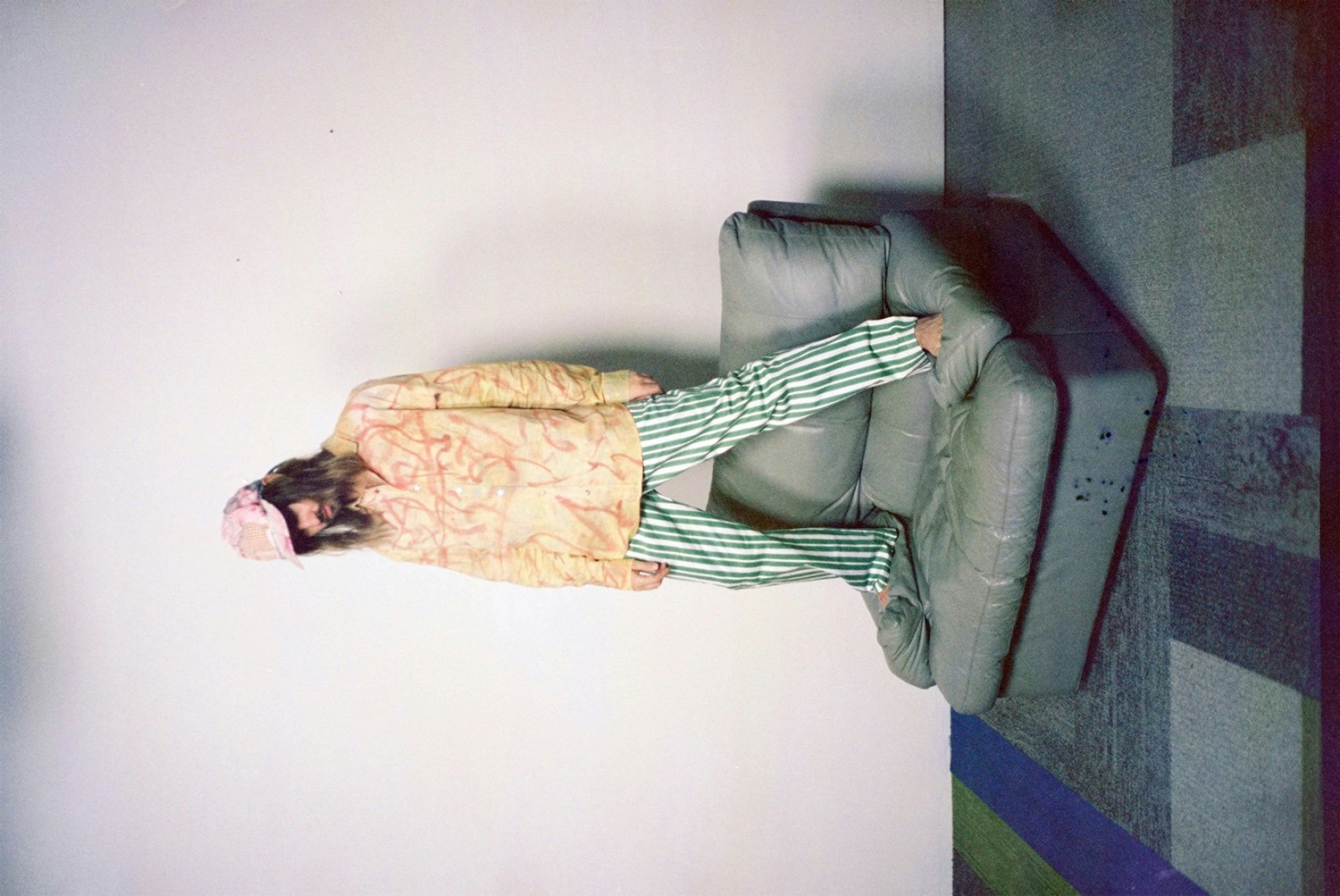
TAME IMPALA
Kevin Parker
Photographs by Caitlyn Talijancich & Benjamin Barretto
Words Glenn Goetze
Time to read
It takes a bit. Chill!
Kevin Parker
Photographs by Caitlyn Talijancich & Benjamin Barretto
Words Glenn Goetze
Time to read
It takes a bit. Chill!


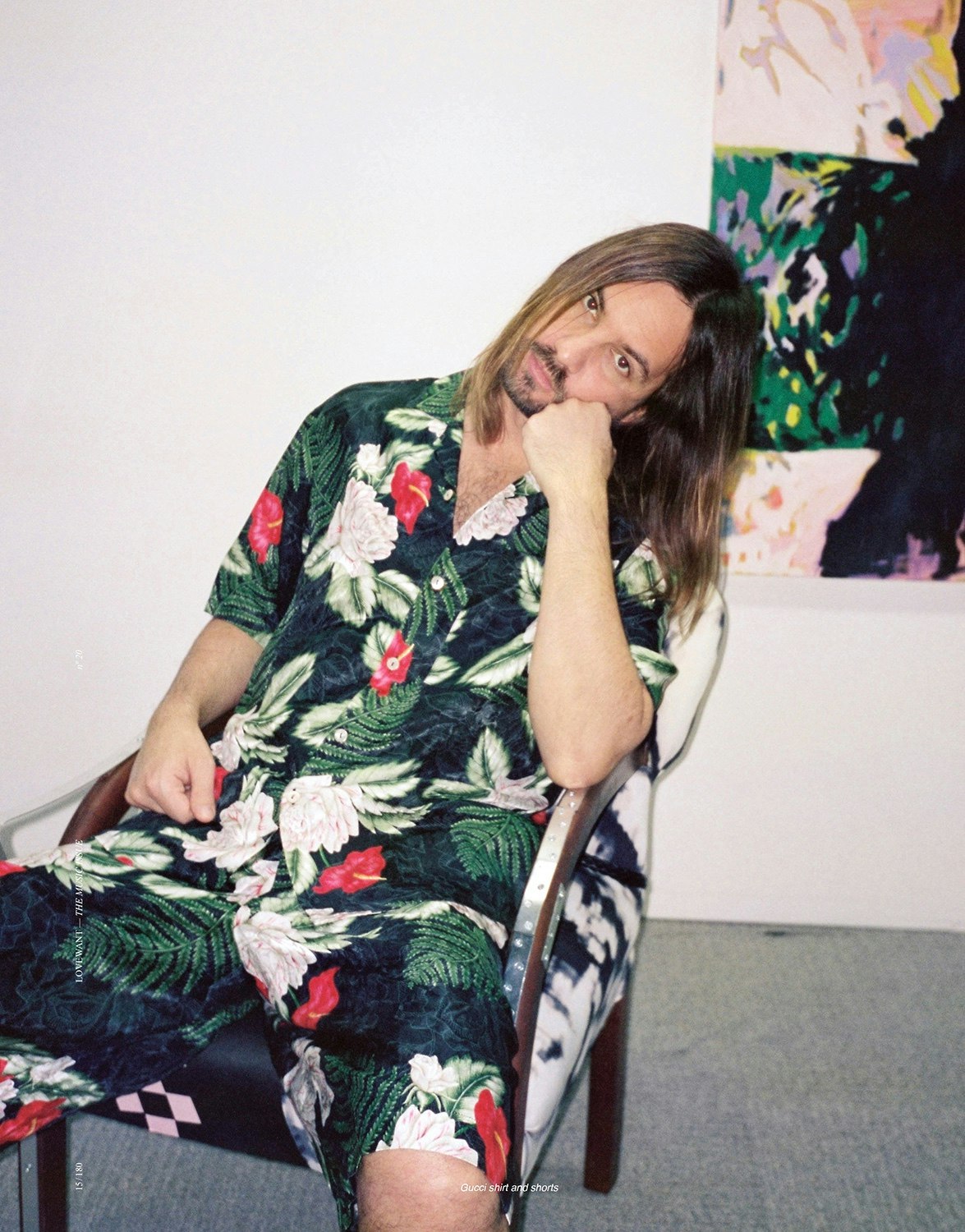
ISOLATIONIST Words by, Glenn Goetze
Kevin Parker was designed for quarantine. Hailing from the world’s most isolated city (Perth, Western Australia), he’s the one-man-band behind the epic musical project known as Tame Impala. He writes, performs and produces everything himself; holed up alone in a studio, he conjures a sound so singular it’s impossible to imagine another creative energy in the mix. His Tame Impala debut, Innerspeaker, came in 2010, followed by Lonerism in 2012, and Currents in 2015, all products of the sounds that somehow form in Parker’s head. Then in February this year we got The Slow Rush, an explosive, heady brew of one man’s meditation on time. He and I first made contact on Myspace at the end of 2007, and soon after he was signed to Modular Records (where I worked at the time). Ever since then we’ve been in an ongoing conversation almost exclusively about music, covering the meta and the microscopic, sometimes within the same WhatsApp message exchange. On the journey from the back rooms of local pubs to stadiums across the globe, our relationship has been one of the most involved and rewarding I’ve had with any artist I’ve had the pleasure to work with. While presented here as an interview, what you’re about to read is actually pretty typical of the kind of ambling chats we have going at any given time. While I’d intended to talk about life beyond music, his passion and curiosity about the potential of sound burns so bright that I fail miserably. GG: Has this forced quarantine shifted your perspective on what you do or how you live your life? KP: Oh man, if anything it’s made me feel like I should be putting my money where my mouth is. I work in isolation, that’s where I thrive. Someone said to me today that it’s funny how introverts are sort of celebrating this time, because suddenly the whole world is on a level playing field, and I honestly do feel like that... I’ve always loved working at night. I’m not supposed to be out with people, I’m not supposed to be interacting... I feel so motivated because being creative in the studio is the only thing I need to be doing then, and so isolation is similar... That’s something that I’ve thrived on my entire life, and I feel extremely lucky that I’ve built my life around that. Literally, I’ve built my whole livelihood around being able to do stuff by myself.
"I decided to do an album was like, “And I’m going to do fucking interviews this time!” And do them properly, you know? I’m better at being able to enjoy doing an interview these days. It used to terrify me. It used to just bug me out. I’d talk and as I’m speaking I’m imagining I’m reading a sentence in a magazine, which is an awful trap to fall into when you’re doing an interview, because it’s so stifling. I just realised the value in doing interviews, which is to put a personality to the music and give the music context by the way of expressing yourself." KEVIN PARKER


GG
Are you still doing much press?
KP
Yeah, I just did Sound On Sound, which is kind of a lifelong press ambition because I get to wax lyrical about equipment.
GG
I feel like you’ve done more press this time around?
KP
Easily.
GG
Why is that?
KP
I just felt like I might as well. Taking time away from music and not being interviewed makes you realise what you’re missing out on. I remember one of the things I was thinking about when

GG
If that’s what readers get, what do you get out of doing interviews?
KP
Reliving the experience of doing it. Because when you make music, you wake up the next morning and you’ve forgotten what it was like to do itm and you forgot why you did things... And at the end of the day, who doesn’t like talking about themselves? I can’t handle the idea that I’m actually someone who likes to talk about themselves, so it’s a good excuse to be able to talk about yourself and how you feel. It’s like therapy.
GG
You didn’t get that sort of same thing earlier on?
KP
No... I felt like it was this whole judgement thing, like I was being judged. It took me a long time to shake that. Fear of being judged, fear of getting a bad review, fear of people thinking that you are a fraud... I feel like that must be something that every artist gets to some degree. The fear that people might figure you out and figure out that you’re doing this for the wrong reasons or something like that. All of those kinds of things come into your mind. Interviews used to feel like they were more like job interviews—it used to feel like someone was like interviewing me to see if I was legit. I kind of just got over that.


GG
Do you think that was due to achieving some sort of success or positive feedback, or was it just that you matured?
KP
When I was making Currents I remember saying to myself. “This is the last album where you care about what people would think.” I was putting my foot down. Innerspeaker, I didn’t even know what Pitchfork was... And then post-Innerspeaker I learnt about the whole music critique world. When I was making Lonerism I was aware of the idea of getting a bad review, and it was something that was kind of hovering above me. I was still doing what I wanted to do, I was still making the music I wanted to make, but it was like that nagging thing. Then with Currents I was starting to not care. I wanted to make a kind of pop music, music that people could dance to. Less and less I cared about it, but it was still there... Then with The Slow Rush, I didn’t care. Obviously I wanted to make music that people thought was good music and good art, something real and something good, but I managed to not care about what people were going to give it out of five. I’m proud of myself for doing that.


GG
Do you think that had an effect on the way you approached The Slow Rush?
KP
Yes, undeniably. Whenever I’d be working on something and I felt like people could enjoy it on a really basic level, like that people are gonna dance to this and have a good time, I would immediately translate that to mean that it was unintellectual. Like that whole thing with dance music being “base level”... which is obviously a stupid fucking indie rock and roller mentality that I used to have. I used to think using pop elements were sort of taboo. I would push that kind of thing down, whereas now if it’s something I want to do, I’ll do it. I’ve learned to value what I like in music, and try and shut everything else out.
GG
If you had to define what you like in music, how would you do that?
KP
I choose not too, it’d be horrible if I did.
GG
You know when you feel it?
KP
Exactly. Does anyone know what they like in music? Spotify probably knows better than we do. It would be awful if you had to describe what you like. “Oh, I like a funky beat that kind of makes me feel sad.” I couldn’t, and I would never attempt to.
GG
It seemed to me like you made a lot more demos for The Slow Rush, am I right on that? I feel like on the previous records it was fairly definitive. The first time I heard anything it was like, “Here’s twelve songs, this is going to be the album.”
KP
No, I think [The Slow Rush] was more like that than you think. Because once I have a moment with a song, once I have a kind of emotional connection to it, it’s my song. It’s important to me emotionally, and the idea of leaving it off an album is a big move. So I actually can’t think of anything I would have played you that didn’t end up going on the album.

GG
So you haven’t revisited any of those early demos since completing the record?
KP
No... I hate revisiting stuff. It takes a lot for me to revisit something that I previously didn’t choose for something. The idea of me picking up a little demo that I had for Lonerism and turning it into a song for an album afterwards would be unheard of. I hate the thought that I’d need to take from a time when I was more inspired, because that’s what it says to me: I can’t write something now that’s as good as something that I did five years ago... But sometimes I’ll listen to demos. There are some from the Currents days, but I cannot bring myself to record them. I don’t know what it is.
GG
Because the moment’s passed?
KP
Yeah. The moment’s passed. For whatever reason at the time I decided that it wasn’t good enough to push on with, and I have to respect the choice that I made back then. But then maybe I was delusional. Maybe I didn’t see something.
GG
You’re a different person now. Maybe a different person would approach it a different way?
KP
I guess. I just hate the idea that I’m not evolving as a songwriter. And for me to do anything that would suggest otherwise terrifies me. For me to realise that something that I discarded five years ago is better than something I can do right now, something I could do in fucking two minutes, it’s just not how I want to feel as an artist. I want to feel like I’m getting better and better.
GG
Has that feeling ever crept in that maybe you’ve already done your best thing?
KP
Absolutely.
GG
It’s kind of in “It Might Be Time”?
KP
Exactly. I feel like that song is like the classic Australian way of joking about something as a way of making light of a heavy idea... That song for me is light-hearted, it’s kind of taking the piss. It’s something that me and Jay always tease each other about, like, “Hey man, you’re over the hill...” I do wonder if I’ll ever write a pop song like “The Less I Know the Better” again. I like to think that I can, and I genuinely believe that I can. GG: I don’t doubt that you can. “The Less I Know the Better” is good but I think you can do better.
GG
I don’t doubt that you can. “The Less I Know the Better” is good but I think you can do better.
KP
Oh cool, man. That’s good to hear. “The Less I Know the Better” is a weird song, anyway.
GG
I always thought, like, where’s the fucking chorus?
KP
So funny. It’s so true. But you know, maybe in 20 years I’ll look back and be like, “Oh, I wouldn’t have had it any other way.” My biggest song has however many million Spotify plays [but] it was never top 40. But maybe I don’t want a conventional pop song... Maybe I like the fact that my most popular song is a really weirdly structured song. Maybe that’s what I’m destined for, but that’s not going to stop me trying. I’m still curious about all the things, you know?
GG
To me, I don’t think you’re incapable of doing it, but I feel like you don’t let yourself write conventional songs.
KP
Yeah. It’s funny, that. I’ve always wanted to just have a pop song under my name, which is a big driving factor in me wanting to collab with pop artists. Take Lady Gaga, for example. That was my opportunity to have a “pop song”. I know that Lady Gaga is not your average pop artist, but the reason I was so interested in doing that kind of stuff is to be able to experience that pop world. But even with that, whenever I start to encroach on the standard pop “way”, it still makes me go, like, “ew”, you know? But I still have that belief that you can still be quirky as fuck and still have a massive pop hit and make something that the whole world falls in love with, like “Hey Ya!” If I could build a monument for “Hey Ya!” I would, because of how much that song defies everything. The song is in 7/4 timing, it’s not even 4/4. It’s a song that everyone knows, everyone loves, but nothing about it is standard. Nothing about it falls into the category of a normal kind of pop music.
GG
Do you think there was a day dot of The Slow Rush where you really focused on trying to start something new?
KP
I just had that kind of feeling that I wanted to make another album. I realised that Tame Impala can be what I want it to be, or it can be what I previously thought it couldn’t. I was inspired by a few different things, a few different processes of making music. After being in the studio with people like Travis Scott I was like, “Fuck yeah! I want this for myself.” Like, I want to experience this in the only way I can as Tame Impala, which is on my own. Watching the making of Justified on YouTube, a candid six-part series about Justin Timberlake’s first solo album—it can’t be understated how much that got me inspired. Watching Pharrell put together a section of music... He was really driving it, you know? He had these keyboards on a little stand, he’d go in and do some drums... It reminded me of what I loved about making music on my own. That excitement, that discovery. The “Señorita” beat, he’s playing drums for I don’t know how many minutes on end. There’s the keyboard that’s going “do, do, do-do, do, do-do” and he’s going “boom, tchakon, boo boom boom tchakon”, keeps playing with it, and then he finally sort of converges on the beat and they’re like, “Ah!”... That kind of process reminded me of what I loved about making music. Previously, I felt like the way I made music wasn’t cool, or something, like it wasn’t badass. But watching that reinvigorated the idea of making music on my own. In essence, him making “Señorita” is the same way that I made Innerspeaker. It really is. It’s just layering things on top: you do something, then you do something on top of it, and you have a vision and you go for it. I had some demos, songs like “On Track”, I had the idea for that walking from my studio to my house. Other songs I thought of because I just think of songs sometimes randomly, but some of the songs I had no idea for starting out, like “Borderline”. Borderline was the result of me listening to a drum break that I’d recorded for I don’t know how many hours, I had it cranked in the LA house for a few hours, just getting drunk and smoking weed and that came of that. Making that song I just pretended I was in one of those sessions in LA. I had the doors open, the skyline was there, I had a view of Hollywood, it’s cheesy as fuck. But I just kind of got into the mindset of being someone somewhere that I want to be. That’s what was inspiring me at the time.


GG
Did you have any of those kinds of eureka moments like Pharrell did when he settles on the “Señorita” beat?
KP
Yeah, absolutely. It’s funny because you spend two hours trying to think of something, and then the moment that you start thinking about something else, it comes to you... It’s like that thing where if someone says, “Don’t think about elephants,” what do you think about? It’s the same for me writing melodies. I can’t say to myself, “Don’t think about it,” because I will. I literally have to just wait until my mind wanders off somewhere else. And there’s a drum beat playing and then my brain will start filling it with notes. Basically, I have to have that eureka moment with a song, or I don’t care for it. There has to be that moment where I go “Ah, yes! This is, this is the best thing I’ve ever written!”, even for a split second. I have to have that at some point.
GG
So you think you had that for every track on the album at some point to some degree?
KP
Yeah. Every track I’ve ever done. I have to have had a moment with it... I hate the idea of designing a melody. It’s a bit pompous and Jay [Watson, who plays in Tame Impala’s live band] has pulled me up on it before. Jay will write a melody if he needs to write a melody, and then he’ll be happy with it. He’s able to remain, in his opinion, objective about it, whereas I need it to feel inspired... It has to seemingly come from somewhere unknown.
GG
And when you lock into that moment where it comes together, is it celebration or relief?
KP
It’s euphoria, it’s relief, it’s everything. I live for that moment. Relief is actually accurate, because sometimes it can be months between eureka moments, and in those months you start to think, “Maybe you’re never going to have one of those moments again?” Sometimes I’m almost brought to tears. Like in Once Upon A Time In Hollywood, when Leonardo DiCaprio’s character gives that performance that totally reinvigorates his acting career and afterwards a little girl comes over and says, “That was the best acting I’ve ever seen,” and then walks away, and he’s holding back the tears because the whole movie he’s been doubting himself, like, “Fuck, I’ve lost it!” It’s that exact feeling. I had that with Currents. I had that with Lonerism. Because I don’t really have a strict method for writing songs, I always assume every good song I write is my last good song, because I don’t know how to write a song, or why I come up with a melody. Relief is a huge part of that eureka moment.
GG
When you say you had the idea for “On Track” walking from your studio to your house, what was it that came to you in that short space of time?
KP
Actually I just got to the house and there was a piano there, so I started playing it and that was that. I just said that line to myself: “Strictly speaking I’m still on track.” I guess that’s one of the songs that I wrote in the most classic way, like Elton John sitting down at a piano with a phrase in his head that he wants to turn into a song, which I was okay with because I wanted this album to be different methods of writing. But I just said that line...
GG
To pep-talk yourself?
KP
Yeah, absolutely. It was probably the convergence of two things. I was worried about my health at that time. I thought I was dying, really. I thought I had cancer or something. Regular hypochondriac stuff. It was a combination of that and my music career. For some reason, those two things combined, and my brain spat out the words: strictly speaking, strictly speaking, everything’s okay. For me, everything looks fucked right now, I think I’m dying and my career might be over, but strictly speaking, I’m still good.
GG
Where do you think making The Slow Rush falls in terms of difficulty you’ve had making records?
KP
It’s a weird combination of being the easiest and the hardest. Like every album I do, I thought it was going to kill me. Every album I’ve done, I’ve just thought I’m gonna fucking have a breakdown and just give up. Innerspeaker, I wanted to give up; I thought it was a piece of shit. Lonerism, I was like, “Well, it’s not as good as Innerspeaker, but as long as people don’t think it’s a piece of shit...” With Currents, I was like, “There’s no way anyone could like this.” But with The Slow Rush, I knew it was a pattern. I knew that I was going to hate it. I knew that I was going to have a hard time making it, so knowing that I just had to push through. I reminded myself to enjoy the music and I achieved that by just listening to it loud.
GG
It’s that simple!
KP
It’s that simple, man.
GG
All this time, you could have just been cranking it up a little bit.
KP
Yeah. But you know what? I didn’t have the speakers to be able to do that back then. With Currents I re-discovered listening to music on my headphones and going for a walk. When I was making Currents, stepping back from the studio and putting the whole thing on my phone and just going for walks and listening to it totally revitalised the songwriting experience. It was a game changer. I’d forgotten that was such a potent experience. I did that with The Slow Rush as well, but also—getting back to working with hip hop—they do it at 120 decibels. And they only do it at 120 decibels. When I first worked with [A$AP] Rocky, I was like “Oh my god, why are we listening to it this loud? Why re we doing this? Can we fucking turn it down please?” Then about an hour in I was like “Oh, I get it, this is how it’s gotta be, and this is the only way I can imagine ever doing it.” I can’t imagine making hip hop not at loud volumes, and now I can’t imagine making my own music at quiet volumes. I know it’s not the smartest way to mix music, but that’s the thing: it smothers over the details that I’m otherwise preoccupied with. You can’t hear things that are out of tune, the drums sound great even if it’s not the best drum sound.
GG
What happens if you hear your music in a social setting, you have to ask people to crank it up?
KP
Yep. This is the other thing I’m no longer embarrassed by, or no longer self conscious about. I used to absolutely cringe into a corner when I’d hear my music or when someone I’m at a party with would be like, “Oh yeah, let’s put on Tame Impala,” and I would assume they were doing it to tease me and I’d wait it out for the song to finish and change the music. Now I ask them to turn it up, because I think it will be more enjoyable for them but also I want to enjoy it with them. I want to enjoy my music. I can listen to my own music for hours on end once I finish a song; I’m pretty sure no one is ever going to listen to that song as much as I have in the twelve months I spent making it. I listened to it all day, every day and I’m loving it all day every day. So why is it that I suddenly can’t when I release the album? I want to be able to enjoy my music with people. Thankfully, for whatever reason, people around me want to listen to The Slow Rush when it’s, like. two in the morning. We’ve had a few of those album playbacks, we did one the other night... I’ve spent my life being self conscious about it and I just want a new experience... And all that kind of stuff is just me embodying Kanye West. It’s me going “Yeah! This song is sick!” even if at the time I don’t fully believe it.
GG
Was there any point making The Slow Rush where you realised it was going to be okay? Or was it torture up until the last minute? There must’ve been a turning point...
KP
robably when I made “Breathe Deeper”. Also when I started to work on “Lost In Yesterday”, because I wanted a super pop song and I didn’t have that until then. But obviously those feelings are fleeting... It can take me a whole day to write a line, and then if I’ve got that line and it delivers the message that I want to deliver—because a single lyric can do that, it can, it can sum up a whole song perfectly—that can make me feel like if every other lyric I write on the album isn’t as good as that lyric, it’s okay.
GG
How do you feel in your skin now, given that you’re four fairly successful records in? Do you feel some sort of contentment or satisfaction that you didn’t previously?
KP
No more than after Currents. In fact it’s exactly the same as I felt after Currents... There’s no way that I’d be satisfied with what I’ve done as it being everything that Tame Impala ever had to offer album-wise. Because sometimes—and this is controversial—in my most optimistic and inspired moments, I feel like I’ve been running at 60 per cent the entire time.
GG
What’s that other 40 doing?
KP
The other 40 is afraid.
GG
Afraid of what?
KP
Afraid of going a hundred percent. And the fear of not being a Stevie Wonder. If I went a hundred percent and it wasn’t Stevie Wonder, I’d feel defeated.


GG
But you’ll be 100 per cent Kevin Parker?
KP
Yeah. This is not to say that I have in any way held back. But witnessing the kind of work ethics that I’ve seen in the last few years—like Gaga, Travis Scott, Mark Ronson, who has a great work ethic—makes me think that maybe I could be doing more. For me, once a song feels complete I don’t want to ruin it, but maybe that means that I’m not testing every possible thing. GG: But I think that’s really a judgment thing. Maybe you wouldn’t get anything more out of anything if you were to keep going. Knowing when to stop is a skill in itself. KP: Yeah, for sure.
GG
I feel like you actually work pretty hard, you maybe just don’t work the same way as those guys do. You work in your own way, and aside from a couple of holidays here and there, there hasn’t been that much time in the last ten years that you haven’t been doing something Tame Impala-related.
KP
No, definitely not. I guess it’s just things like—take the bassline from “The Less I Know the Better”, for example: I only ever played that once. It’s not like I even rehearsed it a few times and then did the take, I just hit record and played it. The wave file of that bassline is five seconds long... I didn’t keep playing to see where that bass riff could go, I didn’t write a chorus, I didn’t write anything more for that song for another ten months or something. I was happy with that little piece of music.
GG
That sort of proves my point though, because you’re talking about arguably the most recognisable feature of your most well known song, and if you’d spent more time on it then it might not have turned out as good?
KP
Obviously I’m using an example where it did turn out good. I think about a song that wasn’t successful and it could have been, and it’s like, “Did I do everything I could have?” Probably not. For me, an un-fucked-with song, that I didn’t stretch in every direction seeking the best thing for it, a song that was allowed to be what it wanted to be naturally, even if it’s not as good for everyone else to listen to, is better than me pushing a song, stretching into every corner, trying to find the best thing for it that will give the song the best enjoyment for everyone. I’m selfish in that way.
GG
So how do you go about freeing up that 40 per cent that’s being held back?
KP
That’s a good question. I think it’s just from self-discipline, which I don’t have at the moment. It’s like physical fitness.
GG
Doing it consistently?
KP
Yeah. Just having self-discipline, because how did Stevie Wonder get so good at writing songs? He wrote a thousand of them. I don’t have a thousand songs, because I just write what I need to write to feel fulfilled, but I guess there’s the difference. The other thing is that I’m well aware my process is kind of destructive and heavy handed. In the studio, I’m really heavy handed and not very methodical, and the way to get more out of it is to be more methodical and more disciplined, which will probably be at the sacrifice of a lot of the charms of the way I do it. So for that reason I’m glad that I’ve done what I’ve done, so whatever I do in the future... I want to be doing different stuff.
GG
From my perspective, every record that you’ve made at the end I’ve felt basically, unequivocally that it was the best thing you’ve done, but—
KP
Oh, wow. Thanks man.
GG
—but I always know you can do better. But I don’t know what that is, and I don’t know if it’s even possible.
KP
What’s funny is the amount of artists that I work with now that have what I call the fish eggs strategy. They machine gun out ideas, like a fish will lay how many eggs? Caviar, right? They just spray them everywhere. Some of them will turn into something, but most of those eggs won’t be anything. And then there’s a dodo, who just lays one egg. Like, “Here is my egg here, and I give it to you.” I’ve never been the type of artist where I just spray ideas down with the assumption that some of them will come to fruition, but maybe I could do that more. With every album I’ve made there’s been almost no B-sides. Speaking to Rick Rubin, I was like, “How was recording the Chilli Peppers?”, and he was like, “They usually have twice as many songs as what ended up going on an album.” Isn’t that mind blowing? There’s another Blood Sugar Sex Magik out there. There’s a whole other Californication.
GG
That might also have something to do with the fact that there’s four people. Maybe there’s more motivation to keep going and do more...
KP
Yeah. That is true.
GG
If Flea’s in the corner like, “Aargh I’ve got another 10 bass riffs...”
KP
Yeah. That is something that I love the idea of more and more, thinking of myself as different personalities in the studio at once—with The Slow Rush more so than ever. One moment I was kind of like the zonked out lead singer in the corner, humming melodies, and then the next morning I’d wake up and I was the lucid producer going, “Oh, what’s this guy done?” Then all at once I felt like I was in a room full of my selves, which is horribly self-involved, but I guess that’s the kind of weird thing that evolves when you’re an artist like me and you make albums on your own. You have to buy into the mythology a little bit.

GG
What drives you now, and how has that changed? I know with Innerspeaker you were trying to prove something to yourself and maybe the people around you. Now that you’ve above and beyond proven you can make great records, what’s the driving force for you now?
KP
I’m always trying to prove something to myself. I still think there is something that I love about what Tame Impala is that I haven’t fully realised yet. There’s something about how I see it and what I want it to be that I haven’t fully done yet. I guess that’s what I mean about the whole 60 per cent thing. For whatever Tame Impala is and whatever I value it as, there’s still more that I haven’t tapped into or haven’t done. I still think that maybe peak Tame Impala hasn’t happened yet, because I’ve just been kind of doing what I need to do to feel the way I want about it. Maybe I haven’t had my Rocky montage Tame Impala moment.

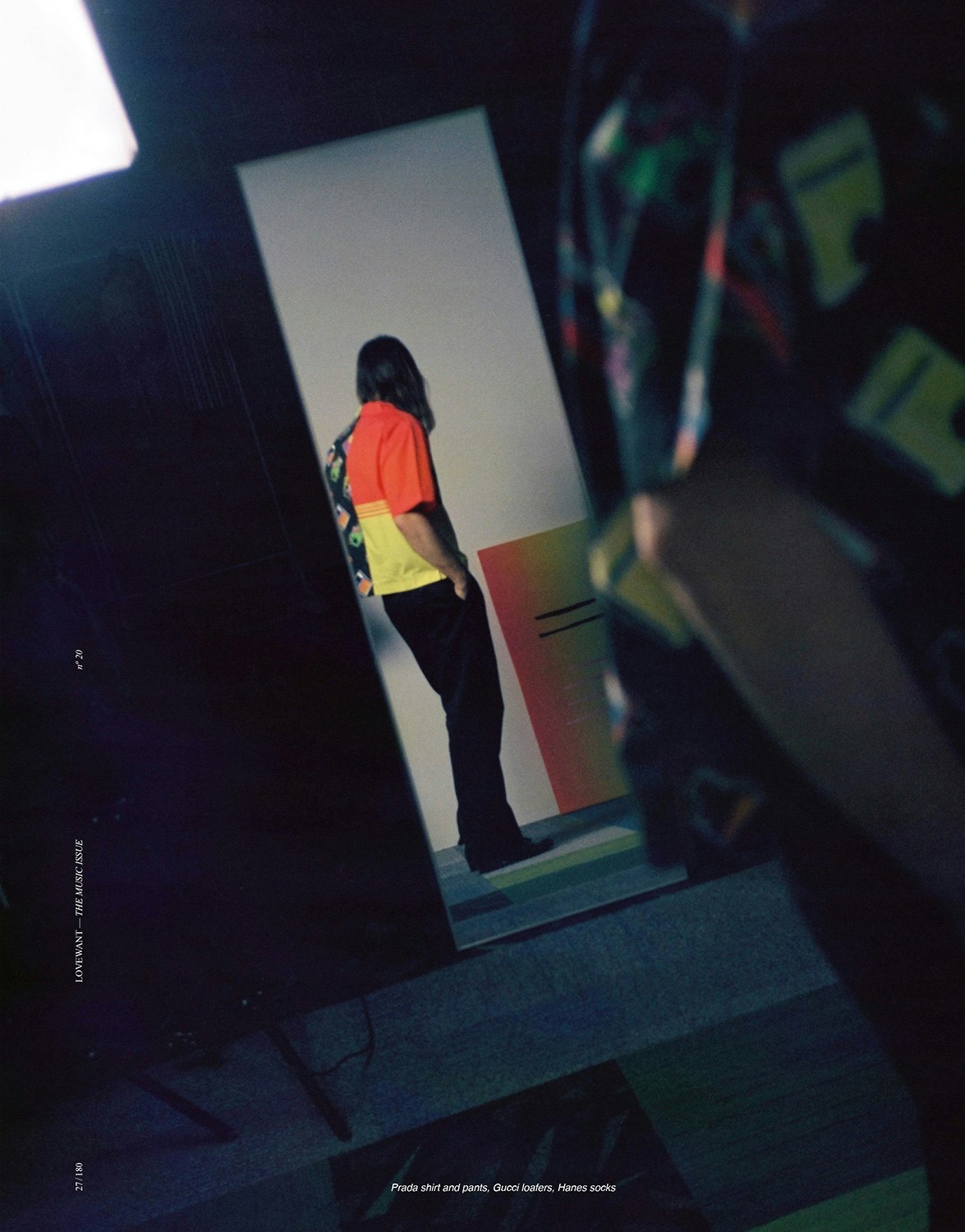
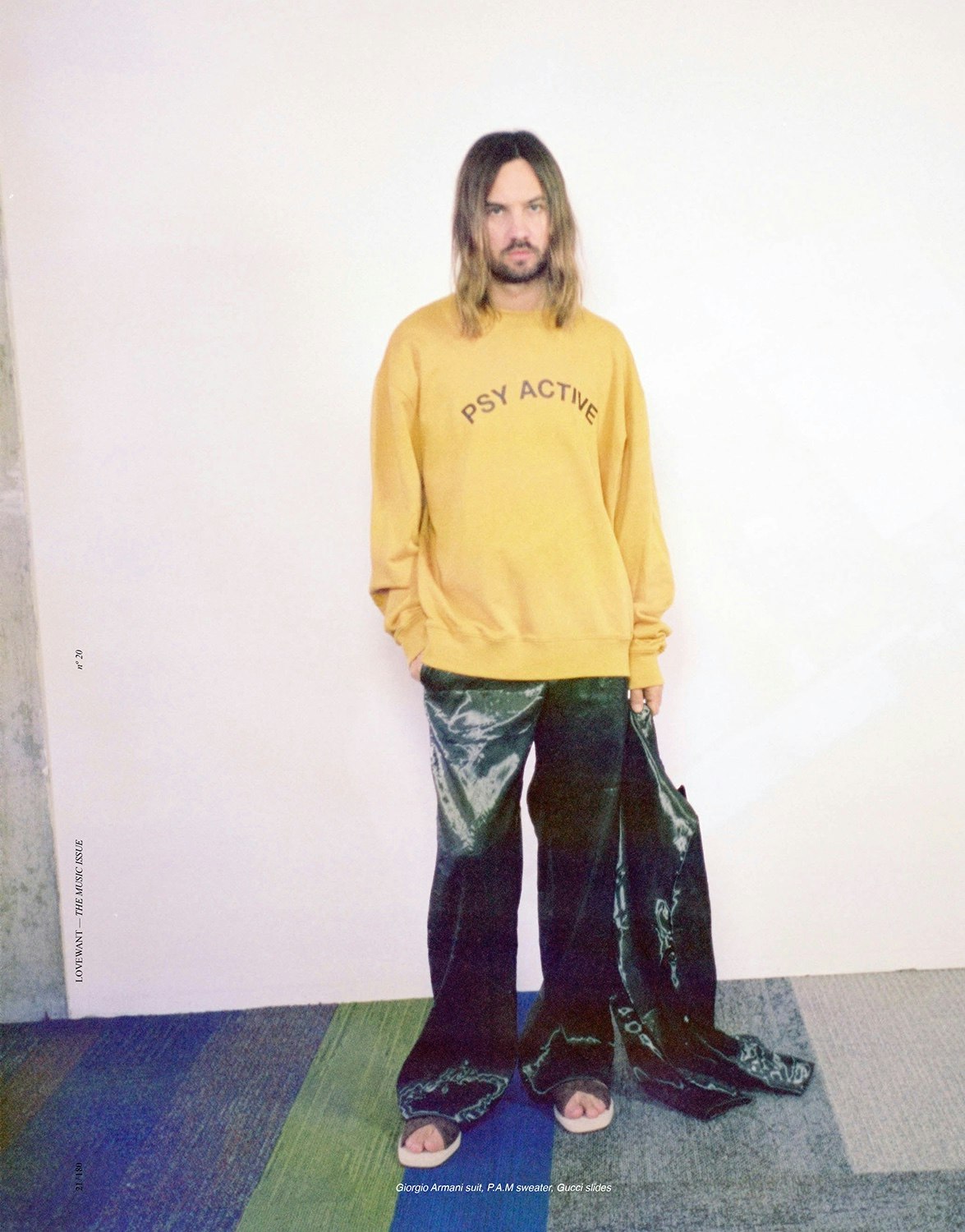
Dressed by: Imogene Barron Casting Director: Bartolomeo Celestino Fashion Assistant: Emily Gibb Photo Assistant: Mitch Pollard Special thanks to Suzy Byrne, Monique Rothstein, Lucy Perrett + Positive Feedback team, Glen Goetze, Kate Green.